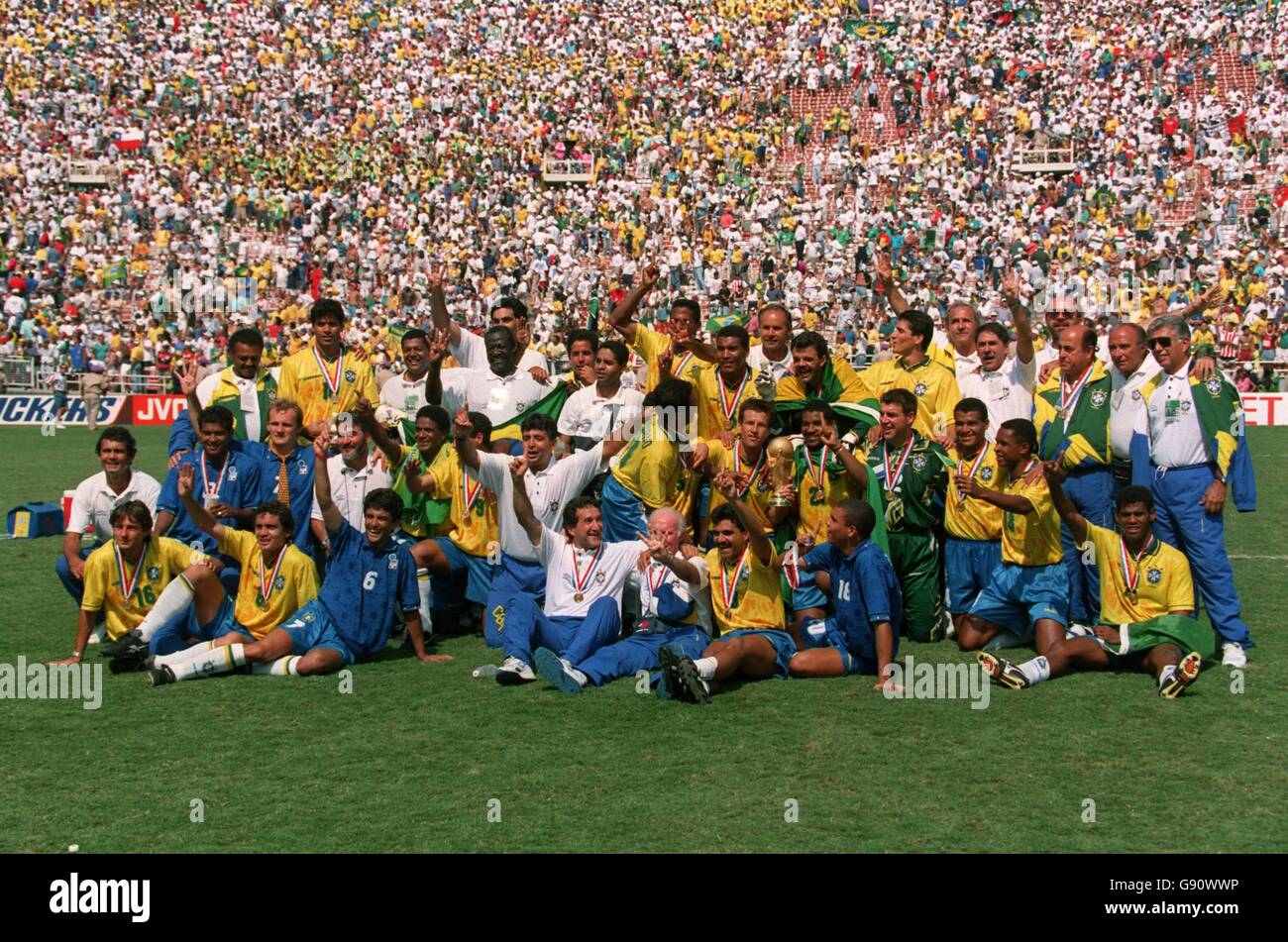
Twenty-four years. That is how long Brazil had to wait. By the time the 1994 Brazilian soccer team landed in the United States for the World Cup, the pressure back home wasn't just intense—it was suffocating. People weren't just asking for a trophy; they were demanding a return to the "Joga Bonito" soul that seemed to have vanished after 1970. What they got instead was a team that redefined how Brazil played the game, swapping samba-infused chaos for a gritty, tactical discipline that drove critics crazy but delivered the fourth star.
Honestly, if you ask a purist about the '94 squad, they might roll their eyes. They’ll talk about the 1982 team with Zico and Socrates as the "true" Brazil. But here’s the thing: that 1982 team lost. The 1994 group, led by a stubborn coach named Carlos Alberto Parreira and a tiny, clinical genius named Romário, actually figured out how to win in the modern era. They weren't just a bunch of guys kicking a ball around. They were a machine.
The Pragmatic Revolution of Carlos Alberto Parreira
Parreira wasn't trying to win a beauty pageant. He knew that Brazilian football had a reputation for being flashy but fragile. To fix it, he did something radical: he prioritized the defense. This wasn't popular. In fact, many Brazilian journalists at the time called his style "Europeanized" or even "cowardly."
But look at the numbers. In the seven games they played during that tournament, they only conceded three goals. Three. That’s insane when you consider they were playing against some of the best attackers in the world. Parreira leaned heavily on a double-pivot in midfield—Mauro Silva and Dunga. Dunga, specifically, became the face of this new era. He wasn't the guy doing step-overs or rainbow flicks. He was the guy barking orders, winning headers, and slide-tackling anyone who dared to breathe near the Brazilian box.
The Romário and Bebeto Connection
You can’t talk about the 1994 Brazilian soccer team without mentioning the "Baixinho" (The Little One). Romário was, quite frankly, a nightmare for defenders. He had this weird habit of disappearing for eighty minutes and then suddenly exploding for a two-second window to poke the ball into the net. He was clinical. He scored five goals in that tournament, but his impact was more than just the scoring. It was the psychological weight he put on the opposition.
Then there was Bebeto.
Their partnership was almost telepathic. Remember the "cradle" celebration against the Netherlands? That wasn't just a cute moment for Bebeto’s newborn son; it was the symbol of a strike force that actually liked each other. While Romário was the predatory finisher, Bebeto was the tireless worker, dragging defenders out of position to create the gaps Romário needed. Together, they accounted for eight of Brazil's eleven goals in the tournament.
What Most People Get Wrong About the 1994 Final
People love to talk about the final against Italy as a boring 0-0 slog that ended in the heartbreak of Roberto Baggio’s missed penalty. They call it a forgettable game.
They’re wrong.
It was a tactical chess match of the highest order. You had the immovable object of Franco Baresi—who, by the way, played that game just weeks after knee surgery—against the unstoppable force of the Brazilian attack. Brazil dominated possession. They took nearly thirty shots. Italy survived because Baresi and Maldini played the games of their lives. It wasn't a "boring" game; it was a high-stakes standoff where the margin for error was literally zero.
When it finally went to penalties, it felt like destiny was finally shifting. When Baggio sent that ball into the California sky, it wasn't just a miss. It was the end of a generation of Brazilian doubt.
The Unsung Heroes of the Squad
We always focus on the stars, but this team had depth that rarely gets the credit it deserves.
- Taffarel: Often overlooked because he didn't have much to do for long stretches, but his save against Daniele Massaro in the shootout was the actual turning point.
- Aldair and Marcio Santos: They formed a center-back pairing that was basically a brick wall. They were calm, technical, and rarely out of position.
- Leonardo and Jorginho: The full-backs. Leonardo’s tournament ended early after that infamous elbow against Tab Ramos of the USA, but Jorginho was arguably the best right-back in the world that year. His cross for Romário’s header against Sweden in the semi-final was a work of art.
Why 1994 Still Matters Today
The 1994 Brazilian soccer team changed the DNA of Brazilian football forever. Before '94, there was a sense that Brazil had to play "pretty" or it didn't count. After '94, the Brazilian FA (CBF) realized that tactical rigidity and physical fitness were just as important as individual flair. This shift paved the way for the 2002 victory in Japan/South Korea. Without the blueprint laid down by Parreira and Dunga, the "Three R’s" (Ronaldo, Rivaldo, Ronaldinho) might never have had the defensive foundation they needed to shine.
It also introduced the world to a young, skinny teenager on the bench named Ronaldo. He didn't play a single minute in 1994, but he watched. He learned. He saw how Romário handled the pressure.
Actionable Insights for Football Historians and Fans
If you want to truly understand the evolution of the game, don't just watch the highlights of the goals. Go back and watch the full 90 minutes of Brazil vs. the Netherlands in the quarter-final. That game is the perfect microcosm of the team: a burst of brilliance, a momentary lapse in concentration, and the sheer mental will to claw back a victory.
What you should do next to deepen your knowledge:
- Analyze the Midfield Shape: Watch how Mauro Silva and Dunga occupy space. Notice how they never both push forward at the same time. This "safety first" mentality is now a staple in almost every successful modern team.
- Study Romário's Movement: Pay attention to his "standing still" phases. He was a master of conserving energy and lull defenders into a false sense of security before making a darting near-post run.
- Read the Tactical Context: Look into the 1990 World Cup failure. Brazil’s exit in the Round of 16 that year is what forced the radical changes we saw in 1994. Understanding the 1990 collapse makes the 1994 triumph feel much more significant.
- Watch the 1994 Final Shootout Again: Don't just look at Baggio. Look at the body language of the Brazilian players. They looked like they knew they were going to win. That confidence was the result of three years of grueling preparation under a coach who refused to listen to the haters.
The 1994 squad wasn't the most beautiful team Brazil ever produced, but it might have been the most important. They proved that Brazil could be both talented and tough. They didn't just win a trophy; they saved Brazilian football from its own nostalgia.