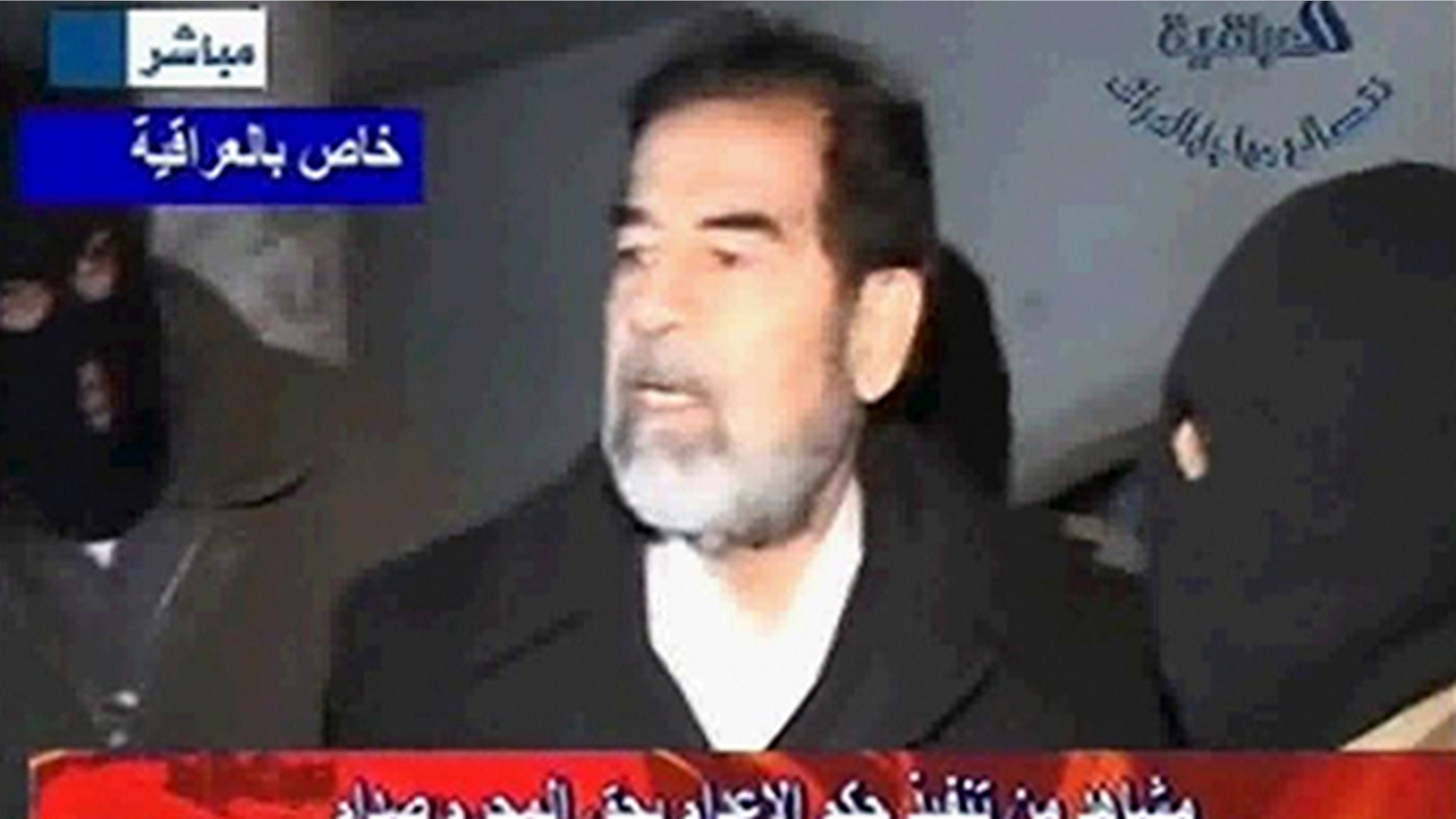
The grainy, cell phone footage changed everything. It wasn't the official version the world was supposed to see. On December 30, 2006, the world woke up to the news that the hanging of Saddam Hussein had been carried out in a secure facility in Khadamiya, a neighborhood in northern Baghdad. But what was meant to be a somber moment of legal closure quickly devolved into a chaotic, sectarian spectacle that haunted international relations for years.
It was cold. Saturday morning. Eid al-Adha was beginning.
While most of the world was sleeping off pre-New Year’s Eve celebrations, a small convoy moved through the darkness of the Green Zone. Saddam, the man who had ruled Iraq with an iron fist for decades, was no longer the "Lion of Babylon." He was a prisoner, designated as "High Value Detainee Number One." He wore a black overcoat and a dark felt hat, which he was told to remove before the end. He refused a hood.
The Trial That Led to the Gallows
Most people remember the end, but the legal road to the execution was long and incredibly messy. The Iraqi High Tribunal focused specifically on the Dujail Massacre of 1982. This wasn't about the invasion of Kuwait or the Anfal campaign against the Kurds—not yet. It was about the killing of 148 Shia Muslims in a single town following an assassination attempt on Saddam.
Human Rights Watch and Amnesty International raised hell about the proceedings. They pointed out that defense lawyers were being assassinated and that the judges seemed to be swapped out whenever they showed too much leniency. It felt like a foregone conclusion. The court sentenced him to death by hanging on November 5, 2006.
The appeal was rejected in December. By then, the clock was ticking.
Inside the Execution Chamber
The room was small. It smelled of damp concrete and old dust. Known as "Camp Justice" (Al-Adala), the site was actually a former headquarters of Saddam’s own military intelligence. The irony wasn't lost on anyone there.
There were observers. Mowaffak al-Rubaie, the national security adviser, was one of them. He later described Saddam as surprisingly collected, yet "broken" in a way that’s hard to put into words. Saddam carried a Quran. He spent his final minutes arguing with the guards.
Then came the chanting. This is what leaked. This is what broke the internet before "going viral" was even a common phrase. In the official, silent video released by the Iraqi government, the execution looked clinical. Professional. Respectful of the law.
But the bootleg version? That was different.
You can hear the witnesses shouting "Muqtada! Muqtada! Muqtada!"—referencing Muqtada al-Sadr, the radical Shia cleric and a fierce rival of the Hussein regime. Saddam smirked. He asked them if this was "manliness." He was mocking his executioners even as the noose was placed around his neck. He started reciting the Shahada, the Muslim profession of faith.
He didn't get to finish the second verse.
The trapdoor dropped at approximately 6:00 AM local time.
Why the Execution Still Matters Today
The hanging of Saddam Hussein didn't bring the peace the Bush administration hoped for. In many ways, it did the opposite. Because the execution was carried out on a major religious holiday, and because of the sectarian taunts heard in the chamber, Saddam—a man who had gassed his own people and filled mass graves—was suddenly viewed as a martyr by some in the Sunni world.
The optics were a disaster. Even then-President George W. Bush later admitted in an interview with PBS that the execution "looked like it was a sectarian revenge killing." It made it harder to argue that the New Iraq was built on the rule of law rather than the rule of the mob.
The Aftermath and the "Missing" Details
There are stories that don't make the history books often. For instance, the fact that Saddam's body was flown on a U.S. military helicopter to a secret location before being handed over to his tribe. Or the weird detail about his shoes—he wanted to keep them on, but they made him change into slippers.
There was also the physical aftermath. The executioner used a "long drop" method, intended to break the neck instantly. It worked, but the violence of the event was captured in leaked photos of the body afterward, showing a significant neck wound that fueled even more conspiracy theories and anger in the streets of Tikrit.
Understanding the Geopolitical Ripple
The power vacuum left by his departure, and the specific way he was removed, set the stage for the rise of insurgent groups. Without the secular (albeit brutal) Ba'athist structure, the sectarian lines in Iraq hardened.
- The Ba'athist Remnants: Many former military officers went underground, eventually providing the tactical backbone for what would become ISIS.
- Iranian Influence: With Saddam gone, the "bulwark" against Iran vanished, allowing Tehran to exert massive influence over Iraqi politics.
- The Kurdish Question: While the Dujail trial finished him, the Kurds felt robbed of their chance to see him tried for the Halabja chemical attacks in a full court setting.
Honestly, the execution was a Rorschach test. If you hated the dictator, it was justice, however flawed. If you feared the chaos that followed, it was a mistake. If you were a legal scholar, it was a missed opportunity for a truly international, transparent tribunal like Nuremberg.
Moving Beyond the History
If you’re looking to understand the modern Middle East, you can’t skip this chapter. It wasn't just the end of a man; it was the end of a specific era of Arab nationalism and the start of a much more fragmented, religious-driven conflict landscape.
To truly grasp the context of the hanging of Saddam Hussein, you should look into these specific areas next:
- Research the Dujail Trial transcripts: Read the actual testimony of the survivors to understand the gravity of the crimes that led to the death penalty.
- Analyze the 2006 "Surge": Look at how the violence in Iraq spiked immediately following the execution during the winter of 2006-2007.
- Study the declassified "Redline" documents: These show how U.S. intelligence tracked Saddam during his time in the "spider hole" before the trial began.
- Compare the Iraqi High Tribunal to the ICC: Look at why the U.S. pushed for a domestic trial instead of sending Saddam to The Hague.
Understanding the nuance of that night in Khadamiya helps explain why Iraq looks the way it does today. It wasn't just a hanging; it was a pivot point for the 21st century.