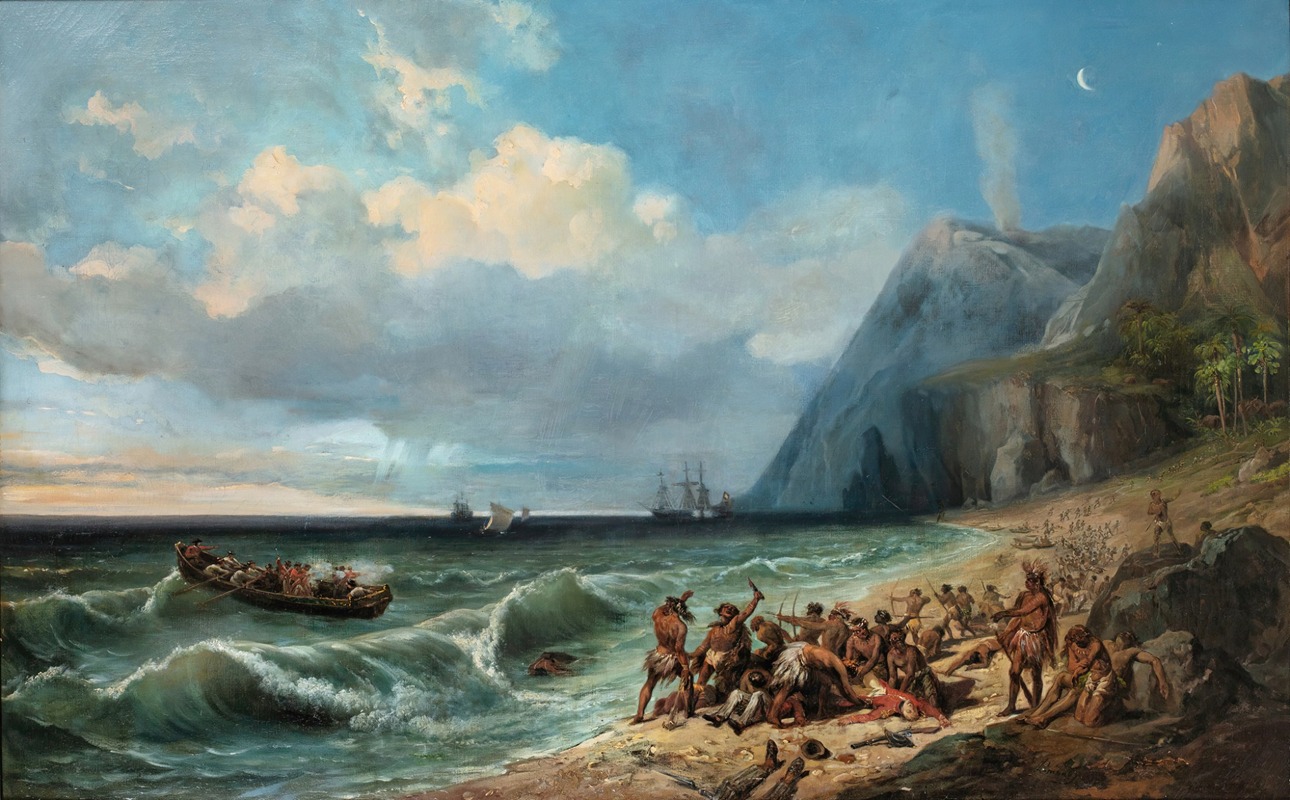
History books usually paint James Cook as this untouchable, legendary navigator who charted the Pacific with surgical precision. But honestly? The way things ended for him was messy, confusing, and arguably avoidable. On February 14, 1779, the "Great Circumnavigator" was killed on a rocky beach in Hawaii. It wasn't a grand naval battle. It was a chaotic, bloody skirmish involving a stolen boat, a botched kidnapping, and a massive cultural misunderstanding that had been simmering for weeks.
Most people think it was just a random outburst of violence. It wasn't. To understand the death of Captain Cook, you have to look at the bizarre timing of his arrival and the incredible pressure his crew put on a local ecosystem that simply couldn't feed hundreds of hungry British sailors indefinitely.
The God Who Stayed Too Long
When Cook first pulled into Kealakekua Bay on the Big Island in January 1779, the timing was eerie. It was the season of Makahiki. This was a time dedicated to Lono, the Hawaiian god of fertility and peace. Because Cook’s ships, the Resolution and the Discovery, had sails that resembled the symbols of Lono, and because he arrived during the specific festival dedicated to that deity, the Hawaiians treated him with an almost overwhelming level of reverence.
They gave him everything.
We’re talking about tons of pork, vegetables, and cloth. But here’s the thing: resources on an island are finite. By the time Cook left in early February, the locals were visibly relieved. The "gods" were finally going home, and the food supplies could start to recover.
Then, the mast broke.
Just days after departing, a severe storm damaged the Resolution's foremast. Cook had to turn back. When he sailed back into Kealakekua Bay on February 11, the vibe had completely shifted. The Makahiki festival was over. The "taboo" against certain activities was back in place. The locals looked at these returning "gods" with a broken ship and saw something much more human—and much more burdensome.
Tensions didn't just rise; they boiled over. Theft became a daily occurrence. The British were frustrated, and the Hawaiians were done being "hosts."
A Stolen Cutter and a Fatal Plan
The spark that lit the fuse was the theft of a small boat—a cutter—from the Discovery. For Cook, this was a matter of naval discipline and prestige. He didn't just want the boat back; he wanted to make a point.
His strategy was one he’d used before in other parts of the Pacific: kidnap the high chief (Aliʻi Nui) and hold him hostage until the stolen property was returned. It was a high-stakes gamble that relied entirely on the locals being intimidated by British firearms and Cook's supposed divine status.
On the morning of February 14, Cook went ashore with a small group of marines. He reached the home of Kalaniʻōpuʻu, the elderly chief. Initially, the chief actually agreed to go with him. He walked toward the boats quite peacefully.
But his wife, Kanona, and other chiefs realized what was happening. They knew that if their king stepped onto that ship, he might never come back. They blocked the path. A massive crowd—estimated at several thousand—gathered at the water's edge.
The Chaos at the Water's Edge
At this exact moment, news reached the crowd that British sailors on the other side of the bay had shot and killed a high-ranking chief named Kalimu.
The mood turned instantly lethal.
Cook was standing between the crowd and his boats. One man approached him with a wooden dagger (a pahoa). Cook fired his small-bore gun, but it was loaded with birdshot and did nothing against the man's thick matting armor. This showed the crowd that the "gods" could be resisted.
When Cook fired his second barrel and actually killed a man, the rush began.
Cook wasn't a warrior in a hand-to-hand sense. He was a navigator. As he turned to signal his boats to stop firing and move closer, he was struck from behind. A chief named Kalanimanokahoowaha hit him over the head with a club, and then another stabbed him in the neck with an iron dagger—ironically, a blade that had been traded to the Hawaiians by Cook’s own crew earlier.
He fell into the surf. He was submerged, dragged onto the rocks, and beaten. The marines in the boats were so close they could see the look on his face, yet the sheer volume of stones and spears being thrown made a rescue impossible.
The Gruesome Aftermath and the "Burial"
There is a common misconception that the Hawaiians ate Captain Cook. This is factually incorrect. While the British were horrified to receive charred remains of their captain days later, the reality was actually a sign of extreme respect in Hawaiian culture.
In 18th-century Hawaii, the bones of powerful chiefs were believed to hold mana (divine power). To preserve this power, the body was ritualistically prepared:
- The flesh was removed from the bones (which involved baking the body to make the process easier).
- The bones were cleaned and kept as sacred relics.
- The heart and liver were sometimes eaten by priests or chiefs as a way to inherit the fallen leader's strength.
When Captain Clerke, who took command after Cook’s death, demanded the return of the body, the Hawaiians eventually handed over bundles of bones and some skin. To the British, this was a barbaric insult. To the Hawaiians, they were returning the most sacred parts of a man they recognized as a formidable leader.
Cook’s remains were eventually put into a coffin and buried at sea in the bay where he died.
Why the Death of Captain Cook Changed History
This wasn't just the end of a man; it was the end of an era of "first contact" that felt somewhat optimistic. After Cook died, the relationship between European explorers and Pacific Islanders became significantly more militarized and cynical.
European journals from the time show a massive shift. They stopped seeing the "noble savage" and started seeing "hostile threats." On the flip side, the Hawaiians realized that these visitors, while possessing incredible technology like cannons and iron, were fundamentally mortal. They could bleed. They could die.
The Role of George Gilbert and Samwell
We know so much about these final moments because of the journals of people like George Gilbert and David Samwell, the ship's surgeon. Samwell’s account is particularly interesting because he was more sympathetic to the Hawaiians than many of the other officers. He argued that Cook had become overly irritable and erratic toward the end, perhaps due to a vitamin deficiency or the sheer stress of the voyage.
There’s even a modern medical theory that Cook was suffering from a parasitic infection (whipworm) that caused his legendary "cool" to evaporate, leading to the lapse in judgment that cost him his life.
Navigating the Legend Today
If you visit Kealakekua Bay today, you'll find a white obelisk marking the spot where he fell. It’s a strange little piece of British territory in the middle of Hawaii. To get there, you either have to hike a grueling trail or take a boat.
The water is crystal clear. It's some of the best snorkeling in the world. But there is a heavy silence there if you know the history. You are standing in the exact place where the world’s most famous explorer realized, too late, that he wasn't a god.
Key Takeaways for History Enthusiasts
If you’re researching the death of Captain Cook, keep these specific nuances in mind to separate fact from colonial myth:
- The "Lono" Coincidence: Cook’s arrival during the Makahiki festival was a fluke of timing that set up impossible expectations for his return.
- The Iron Dagger: The weapon used to kill Cook was likely forged from iron he had traded to the islanders, a grim poetic irony.
- Not Cannibalism: The ritual treatment of his body was a high honor in Hawaiian culture, not an act of consumption for food.
- The Foremast Failure: If the Resolution's mast hadn't snapped, Cook would have sailed away as a living legend rather than dying as a perceived intruder.
To really understand this event, you should look into the journals of John Ledyard, the only American on the voyage. His perspective is often much grittier than the official Admiralty versions. You might also look at the work of historian Gananath Obeyesekere, who challenged the "God-Cook" narrative in his book The Apotheosis of Captain Cook, sparking a famous debate with Marshall Sahlins about how much the Hawaiians actually believed Cook was divine.
The reality is likely somewhere in the middle. Cook was a man of his time—brilliant, brave, but ultimately blinded by his own sense of authority.
Next Steps for Deepening Your Knowledge:
- Read Primary Sources: Locate the digitized journals of David Samwell for the most detailed eye-witness account of the skirmish.
- Visit Virtually: Use satellite mapping to look at the geography of Kealakekua Bay; you’ll see how the narrow beach trapped Cook’s party against the cliffs.
- Explore the Debate: Research the "Sahlins-Obeyesekere" debate to see how modern historians view the cultural clash from both the British and Hawaiian perspectives.